
11 KiB
lab
| lab | ||||
|---|---|---|---|---|
|
Lab 11 - Implement Monitoring
Lab requirements
This lab requires an Azure subscription. Your subscription type may affect the availability of features in this lab. You may change the region, but the steps are written using East US.
Estimated timing: 40 minutes
Lab scenario
Your organization has migrated their infrastructure to Azure. It is important that Administrators are notified of any significant infrastructure changes. You plan to examine the capabilities of Azure Monitor, including Log Analytics.
Interactive lab simulation
There is an interactive lab simulation that you might find useful for this topic. The simulation lets you to click through a similar scenario at your own pace. There are differences between the interactive simulation and this lab, but many of the core concepts are the same. An Azure subscription is not required.
- Implement monitoring. Create a Log Analytics workspace and Azure-automation solutions. Review monitoring and diagnostic settings for virtual machines. Review Azure Monitor and Log Analytics functionality.
Architecture diagram

Tasks
- Task 1: Provision the lab environment.
- Task 2: Create the Azure activity log alert.
- Task 3: Trigger the alert.
- Task 4: Add an alert processing rule to the alert.
- Task 5: Use Log Analytics to locate the alert.
Task 1: Provision the lab environment
In this task, you will deploy a virtual machine that will be used to test monitoring scenarios.
-
If necessary, download the \Allfiles\Labs\11\az104-11-vm-template.json and \Allfiles\Labs\11\az104-11-vm-parameters.json lab files to your computer.
-
Sign in to the Azure portal -
http://portal.azure.com. -
From the Azure portal, search for and select
Deploy a custom template. -
On the custom deployment page, select Build you own template in the editor.
-
On the edit template page, select Load file.
-
Locate and select the \Allfiles\Labs\11\az104-11-vm-template.json file and select Open.
-
Select Save.
-
On the custom deployment page, select Edit parameters.
-
On the edit parameters page, select Load file. Locate and select the \Allfiles\Labs\11\az104-11-vm-parameters.json file and select Open.
-
Select Save.
-
Use the following information to complete the custom deployment fields, leaving all other fields with their default values:
Setting Value Subscription Your Azure subscription Resource group az104-rg11(If necessary, select Create new)Region East US Username StudentPassword Provide a complex password -
Select Review + Create, then select Create.
-
Wait for the deployment to finish, then click Go to resource group.
-
Review what resources were deployed including a virtual machine and virtual network.
Note: Later in the lab we will be using Azure Monitor so take a minute to install the virtual machine agent
-
In the portal, search for and select Monitor.
-
Take a minute to review all the insights, detection, triage, and diagnosis tools that are available.
-
Select VM Insights View, and then select Configure Insights.
-
Select your virtual machine, and then Enable (twice).
-
It will take a few minutes for the agent to install and configure, proceed to the next step.
Task 2: Create the Azure activity log alert
-
On the Azure portal search for and select Monitor.
-
In the Monitor menu, select Alerts.
-
Select Create + and select Alert rule. The Create an alert rule pane appears with the Scope section open and the Select a resource pane open on the right.
-
In the Select a resource pane, the Filter by subscription field should already be populated. In the Filter by resource type dropdown list, search for and select Virtual machines.
-
You want an alert when any virtual machine in your resource group is deleted. Select the box for the az104-rg11 resource group, then select Apply.
-
Select the Condition tab and then select the See all signals link.
-
Search for and select Delete Virtual Machine (Virtual Machines). Select Apply
-
You want to receive alerts of all types, so leave Alert logic settings at their default of All selected. Leave the Create an alert rule pane open for the next section.
Task 3: Add an email alert action
For the previous Azure Monitor alert, you didn't add any actions. You just viewed triggered alerts in the Azure portal. Actions let you send an email for notifications, to trigger an Azure function, or to call a webhook. In this exercise, we're adding an email alert when VMs are deleted.
-
On the Create an alert rule pane, select the Next: Actions button, and select Create action group.
-
On the Basics tab, enter the following values for each setting.
Setting Value Project details Subscription your subscription Resource group az104-rg11 Region Global (default) Instance details Action group name Alert the operations team Display name AlertOpsTeam -
Select Next: Notifications, and enter the following values for each setting.
Setting Value Notification type Select Email/SMS message/Push/Voice Name VM was deleted -
Select Email, and in the Email box, enter your email address, and then select OK.
-
Select Review + create to validate your input.
-
Select Create.
-
The Create an alert rule pane reappears. Select the Next: Details button and enter the following values for each setting.
Setting Value Alert rule name VM was deleted Description A VM in your resource group was deleted -
Expand the Advanced options section and confirm that Enable alert rule upon creation is selected.
-
Select Review + create to validate your input, then select Create.
Note: Recipients added to the configured action group (operations team) receive a notification:
- When they're added to the action group
- When the alert is activated
- When the alert is triggered
Task 4: Trigger the alert
To trigger an alert, delete the virtual machine in the resource group.
Note: It can take up to five minutes for an activity log alert rule to become active. In this exercise, if you delete the virtual machine before the rule deploys, the alert rule might not be triggered.
-
On the Azure portal menu or from the Home page, select Virtual machines.
-
Check the box for the az104-vm0 virtual machine.
-
Select Delete from the menu bar.
-
Type "yes" in the Confirm delete field, then select Delete.
-
In the title bar, select the Notifications icon and wait until vm1 is successfully deleted.
-
You should have received a notification email that reads, Important notice: Azure Monitor alert VM was deleted was activated... If not, open your email program and look for an email from azure-noreply@microsoft.com.

-
On the Azure portal resource menu, select Monitor, and then select Alerts in the menu on the left.
-
You should have three verbose alerts that were generated by deleting vm1.
-
Select the name of one of the alerts (For example, VM was deleted). An Alert details pane appears that shows more details about the event.
Task 5: Add an alert processing rule to the alert
We're going to schedule a one-time, overnight, planned maintenance. It starts in the evening and continues until the next morning.
-
In the Azure portal resource menu, select Monitor, select Alerts in the menu on the left, and select Alert processing rules in the menu bar.
-
Select + Create.
-
Check the box for your sandbox resource group as the scope of the alert processing rule, then select Apply.
-
Select Next: Rule settings, then select Suppress notifications.
-
Select Next: Scheduling.
-
By default, the rule works all the time, unless you disable it. We're going to define the rule to suppress notifications for a one-time overnight planned maintenance. Enter these settings for the scheduling of the alert processing rule:
Setting Value Apply the rule At a specific time Start Enter today's date at 10pm. End Enter tomorrow's date at 7am. Time zone Select the local timezone. 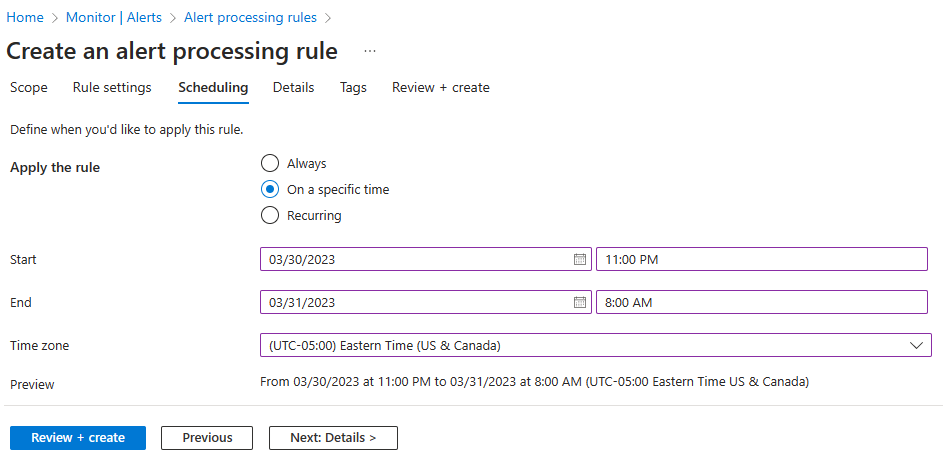
-
Select Next: Details and enter these settings:
Setting Value Resource group Select your sandbox resource group. Rule name Planned Maintenance Description Suppress notifications during planned maintenance. -
Select Review + create to validate your input, then select Create.
Task 6: Use Azure Monitor to query the logs
-
In the portal, search for and select
Monitor. -
Select Logs and notice, in the query window, queries can be run against Application Insights, Log Anaylytics Workspaces, and Virtual Machines.
-
Select Virtual machines, and then in the Count hearbeats box select Load to Editor.
-
Review the KQL query structure. Notice this query is on the Heartbeat table. Other Table choices are shown in the right pane.
-
Click on Time range and notice you can adjust the time range manually.
-
Click Run to execute the query. Depending on the virtul machine usage, you may not find any records.
Review the main points of the lab
Congratulations on completing the lab. Here are the main takeaways for this lab.
-
Alerts help you detect and address issues before users notice there might be a problem with your infrastructure or application.
-
You can alert on any metric or log data source in the Azure Monitor data platform.
-
An alert rule monitors your data and captures a signal that indicates something is happening on the specified resource.
-
An alert is triggered if the conditions of the alert rule are met. Several actions (email, SMS, push, voice) can be initiated and sent to an action group.
Cleanup your resources
If you are working with your own subscription take a minute to delete the lab resources. This will ensure resources are freed up and cost is minimized. The easiest way to delete the lab resources is to delete the lab resource group.
-
In the Azure portal, select the resource group, select Delete the resource group, Enter resource group name, and then click Delete.
-
Using Azure PowerShell,
Remove-AzResourceGroup -Name resourceGroupName. -
Using the CLI,
az group delete --name resourceGroupName.