
13 KiB
Lab 04 - Implement Virtual Networking
Lab requirements
This lab requires an Azure subscription. Your subscription type may affect the availability of features in this lab. You may change the region, but the steps are written using East US and West Europe.
Estimated time: 40 minutes
Lab scenario
Your global organization plans to implement virtual networks. These networks are in East US, West Europe, and Southeast Asia. The immediate goal is to accommodate all the existing resources. However, the organization is in a growth phase and wants to ensure there is additional capacity for the growth.
The CoreServicesVnet virtual network is deployed in the East US region. This virtual network has the largest number of resources. The network has connectivity to on-premises networks through a VPN connection. This network has web services, databases, and other systems that are key to the operations of the business. Shared services, such as domain controllers and DNS are located here. A large amount of growth is anticipated, so a large address space is necessary for this virtual network.
The ManufacturingVnet virtual network is deployed in the West Europe region, near the location of your organization's manufacturing facilities. This virtual network contains systems for the operations of the manufacturing facilities. The organization is anticipating a large number of internal connected devices for their systems to retrieve data from, such as temperature, and needs an IP address space that it can expand into.
Interactive lab simulation
An interactive lab simulation is available for this topic. The simulation lets you to click through a similar scenario at your own pace. There are differences between the interactive simulation and this hosted lab, but the core concepts and ideas being demonstrated are the same. An Azure subscription is not required.
Tasks
- Task 1: Create a resource group.
- Task 2: Create the CoreServicesVnet virtual network and subnets.
- Task 3: Create the ManufacturingVnet virtual network and subnets.
- Task 4: Configure a Network Security Group.
Architecture diagram

| Virtual Network | VNet address and region | Subnet | Subnet address |
|---|---|---|---|
| CoreServicesVnet | 10.20.0.0/16 East US | SharedServicesSubnet | 10.20.10.0/24 |
| DatabaseSubnet | 10.20.20.0/24 | ||
| ManufacturingVnet | 10.30.0.0/16 West Europe | SensorSubnet1 | 10.30.20.0/24 |
| SensorSubnet2 | 10.30.21.0/24 |
These virtual networks and subnets are structured in a way that accommodates existing resources yet allows for the projected growth. Let's create these virtual networks and subnets to lay the foundation for our networking infrastructure.
Did you know?: It is a good practice to avoid overlapping IP address ranges to reduce issues and simplify troubleshooting. Overlapping is a concern across the entire network, whether in the cloud or on-premises. Many organizations design an enterprise-wide IP addressing scheme to avoid overlapping and plan for future growth.
Task 1: Create a resource group
Create a resource group for all the resources in this lab.
-
Sign in to the Azure portal -
http://portal.azure.com. -
Search for and select Resource groups, then select + Create.
-
Create the resource group with these settings.
| Tab | Option | Value |
|---|---|---|
| Basics | Resource group | az104-rg4 |
| Region | (US) East US | |
| Tags | No changes required |
- When finished select Review + create and then Create.
Task 2: Create the CoreServicesVnet virtual network and subnets
The organization plans a large amount of growth for core services. In this task, you create the virtual network and the associated subnets to accommodate the existing resources and planned growth.
-
Search for and select Virtual Networks.

-
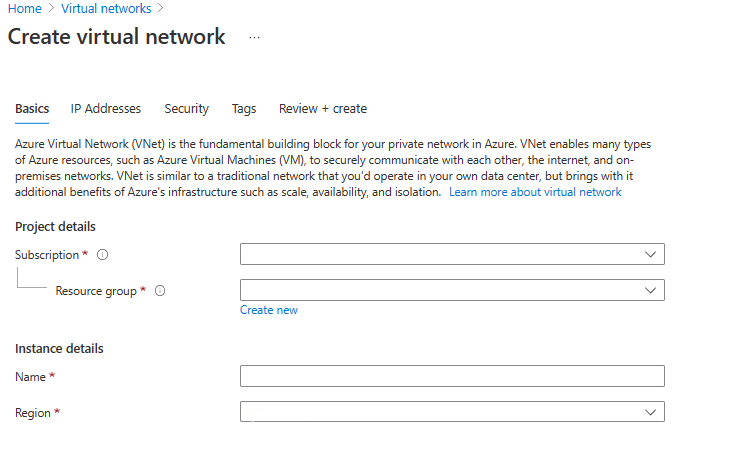
Select Create on the Virtual networks page.
-
Use the information in the following table to create the CoreServicesVnet virtual network.
| Tab | Option | Value |
|---|---|---|
| Basics | Resource Group | az104-rg4 |
| Name | CoreServicesVnet |
|
| Region | (US) East US | |
| IP Addresses | IPv4 address space | 10.20.0.0/16 (Delete or overwrite the IP address space) |

- Create the CoreServicesVnet subnets. To begin delete the default subnet, then select + Add subnet. To finish creating each subnet, select Add.
| Subnet | Option | Value |
|---|---|---|
| SharedServicesSubnet | Subnet name | SharedServicesSubnet |
| Starting address | 10.20.10.0 |
|
| Size | /24 |
|
| DatabaseSubnet | Subnet name | DatabaseSubnet |
| Starting address | 10.20.20.0 |
|
| Size | /24 |
-
To finish creating the CoreServicesVnet and its associated subnets, select Review + create.
-
Verify your configuration passed validation, and then select Create.
-
Wait for the virtual network to deploy and then select Go to resource.
-
In the Automation section, select Export template, and then wait for the template to be generated.
-
Download the template.
-
Navigate on the local machine to the Downloads folder and Extract all the files in the downloaded zip file.
-
Before proceeding ensure you have two files template.json and parameters.json. Take a minute to review the files and the information about the CoreServicesVnet. You will use this template to create the ManufacturingVnet in the next task.
Task 3: Create the ManufacturingVnet virtual network and subnets
In this task, you create the ManufacturingVnet virtual network and associated subnets. The organization anticipates growth for the manufacturing offices so the subnets are sized for the expected growth.
- Edit the local template.json file in the Downloads folder. If you are using Visual Studio Code be sure you are working in a trusted window and not in restricted mode.
Make changes for the ManufacturingVnet virtual network
-
Replace all occurrences of CoreServicesVnet with
ManufacturingVnet. -
Replace all occurrences of eastus with
westeurope. -
Replace all occurrences of 10.20.0.0/16 with
10.30.0.0/16.
Make changes for the ManufacturingVnet subnets
-
Change all occurrences of SharedServicesSubnet to
SensorSubnet1. -
Change all occurrences of 10.20.10.0/24 to
10.30.20.0/24. -
Change all occurrences of DatabaseSubnet to
SensorSubnet2. -
Change all occurrences of 10.20.20.0/24 to
10.30.21.0/24. -
Read back through the file and ensure everything looks correct.
-
Be sure to Save your changes.
Note: If this is just getting too difficult, the final completed files are in the Lab 04 Downloads folder.
Make changes to the parameters.json file
-
Edit the local parameters.json file and change CoreServicesVnet to
ManufacturingVnet. -
Make sure everything looks correct and Save your changes.
Note: You can now deploy the template with either Azure PowerShell (option 1) or the Bash shell (option 2). Your choice, but only do one type of deployment.
Deploy the template with Azure Powershell (option 1)
-
Open the Cloud Shell, and select PowerShell.
-
If necessary, use the Advanced settings to create disk storage for the Cloud Shell. Detailed steps are in Lab 03.
-
In the Cloud Shell, use the Upload icon to upload the template and parameters files. You will need to upload each separately.
-
Verify your files are available in the Cloud Shell storage.
dir -
Deploy the template to the az104-rg4 resource group.
New-AzResourceGroupDeployment -ResourceGroupName az104-rg4 -TemplateFile template.json -TemplateParameterFile parameters.json -
Ensure the command completes and the ProvisioningState is Succeeded.
Note: If you need to make changes to the files, be sure rm (remove) the old file before uploading the new one.
-
Before continuing, return to the portal and ensure the ManufacturingVnet virtual network and subnets were created. You may need to Refresh the virtual networks page.
Deploy the template with Bash (option 2)
-
Open the Cloud Shell, and select Bash.
-
If necessary, use the Advanced settings to create disk storage for the Cloud Shell.
-
In the Cloud Shell, use the Upload icon to upload the template and parameters files. You will need to upload each separately.
-
Verify your files are available in the Cloud Shell storage.
ls -
Deploy the template to the az104-rg4 resource group.
az deployment group create --resource-group az104-rg4 --template-file template.json --parameters parameters.json -
Ensure the command completes and the ProvisioningState is Succeeded.
-
Return to the portal, and ensure the ManufacturingVnet and associate subnets were created. You may need to Refresh the virtual networks page.
Task 4: Configure a Network Security Group
In this task, we create a network security group, associate it with a subnet, and add inbound and outbound rules.
Create an application security group
-
In the Azure portal, search for and select Application security groups.
-
Click Create and provide the basic information.
Setting Value Subscription your subscription Resource group az104-rg4 Name asg-webRegion (US) East US -
Click Review + create and then after the validation click Create.
Create the network security group and associate it with a subnet
-
In the Azure portal, search for and select Network security groups.
-
Select Create and provide information on the Basics tab.
Setting Value Subscription your subscription Resource group az104-rg4 Name myNSGSecureRegion (US) East US -
Click Review + create and then after the validation click Create.
-
After the NSG is created, click Go to resource.
-
Under Settings click Subnet and then Associate.
Setting Value Virtual network CoreServicesVnet (az104-rg4) Subnet SharedServicesSubnet -
Click OK to save the association.
Configure an inbound security rule
-
In the Settings area, select Inbound security rules.
-
Review the default inbound rules. Notice that only other virtual networks and load balancers are allowed access.
-
Click Add inbound port rule . Click Add when you are done.
Setting Value Source Any Source port ranges ***** Destination Application security group Destination application security groups asg-web Service Custom (notice your other choices) Destination port ranges 80,443 Protocol TCP Action Allow Priority 100 Name AllowInternet