
11 KiB
lab
| lab | ||||
|---|---|---|---|---|
|
Lab 05 - Implement Intersite Connectivity
Student lab manual
Exercise scenario
Your organization segments core IT apps and services (such as DNS and security services) from other parts of the business, including your manufacturing department. However, in some scenarios, apps and services in the core area need to communicate with apps and services in the manufacturing area. In this lab, you will configure connectivity between the segmented areas. This is a common scenario which is also popular for separating production from development or separting one subsidiary from another.
In this unit, you will:
- Task 1: Create a core services virtual machine and virtual network
- Task 2: Create a manufacturing services virtual machine and virtual network
- Task 3: Connect to a VM using RDP
- Task 4: Test the connection between the VMs
- Task 5: Create VNet peerings between VNets
- Task 6: Test the connection between VMs
Note: An interactive lab simulation is available that allows you to click through this lab at your own pace. You may find slight differences between the interactive simulation and the hosted lab, but the core concepts and ideas being demonstrated are the same.
Estimated time: 30 minutes
Architecture diagram

Task 1: Create a core services VM and network
In this task, you will create a core services virtual network with a virtual machine.
-
From the Azure portal, search for and navigate to Virtual Machines.
-
From the virtual machines page, select Create then select Azure Virtual Machine.
-
On the Basics tab, use the following information to complete the form, and then select Next: Disks >. For any setting not specified, leave the default value.
Setting Value Subscription The subscription that you have access to Resource group az104-rg5(If necessary, select Create new. Use this group for all your lab resources.)Virtual machine name CoreServicesVMRegion East US Availability options No infrastructure redundancy required Image Windows Server 2019 Datacenter: x64 Gen2 Size Standard_DS2_v3 Username localadminPassword Provide a complex password 
-
On the Disks tab, set the OS disk type to Standard HDD, and then select Next: Networking >.
-
On the Networking tab, for Virtual network, select Create new.
-
Use the following information to configure the virtual network, and then select Ok. If necessary, remove or replace the existing address range.
Setting Value Name CoreServicesVNet(Create new)Address space 10.0.0.0/16Subnet Name CoreSubnet address range 10.0.0.0/24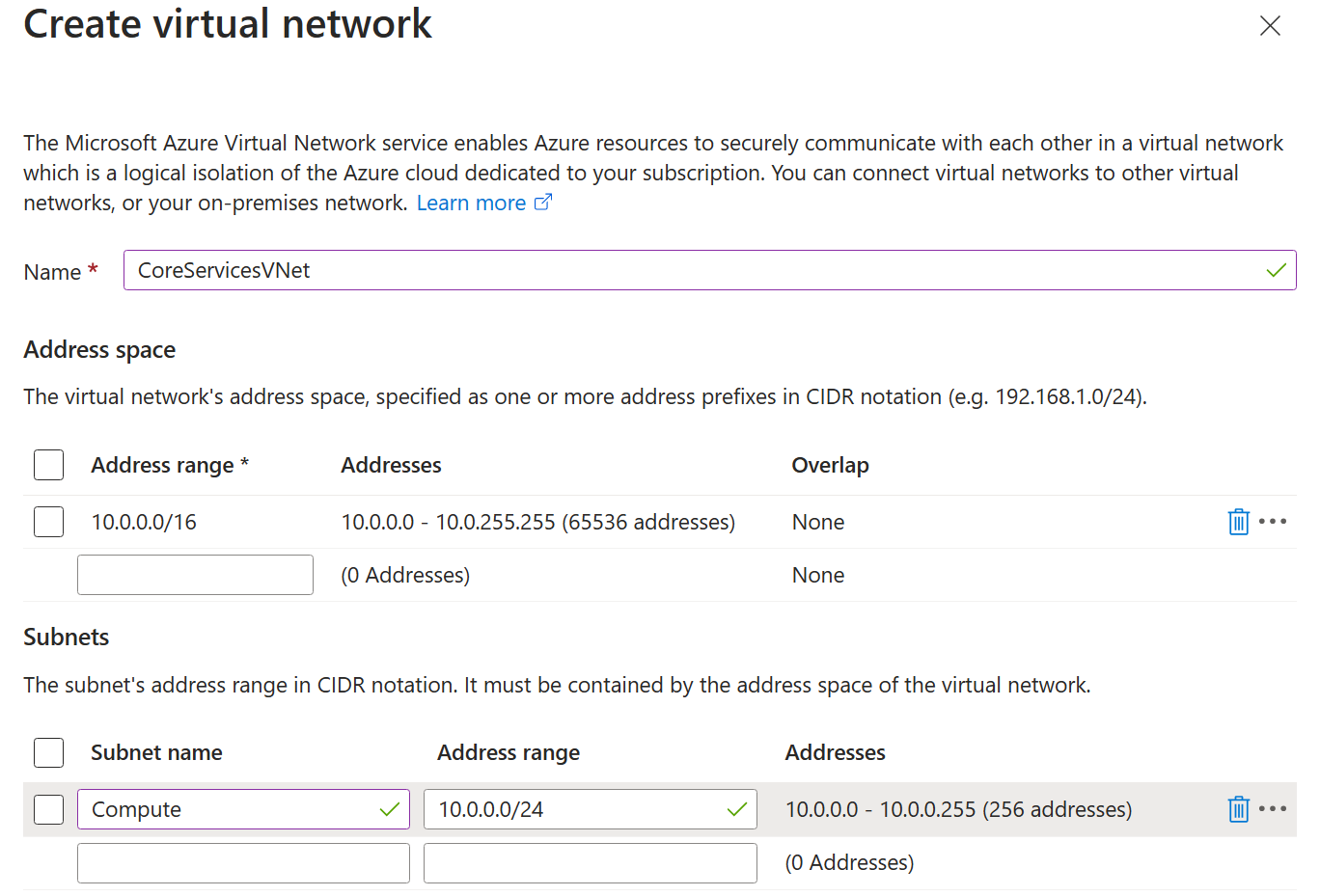
-
Select the Monitoring tab. For Boot Diagnostics, select Disable.
-
Select Review + Create, and then select Create.
-
You do not need to wait for the virtual machine to be created. Continue on to the next task.
Task 2: Create the manufacturing services VM and network
In this task, you will create a manufacturing services virtual network with a virtual machine.
-
From the Azure portal, search for and navigate to Virtual Machines.
-
From the virtual machines page, select Create then select Azure Virtual Machine.

-
On the Basics tab, use the following information to complete the form, and then select Next: Disks >. For any setting not specified, leave the default value.
Setting Value Subscription The subscription that you have access to Resource group az104-rg1(If necessary, select Create new.)Virtual machine name ManufacturingVMRegion East US Availability options No infrastructure redundancy required Image Windows Server 2019 Datacenter: x64 Gen2 Size Standard_DS2_v3 Username localadminPassword Provide a complex password 
-
On the Disks tab, set the OS disk type to Standard HDD, and then select Next: Networking >.
-
On the Networking tab, for Virtual network, select Create new.
-
Use the following information to configure the virtual network, and then select Ok. If necessary, remove or replace the existing address range.
Setting Value Name ManufacturingVNetAddress space 172.16.0.0/16Subnet Name ManufacturingSubnet address range 172.16.0.0/24
-
Select the Monitoring tab. For Boot Diagnostics, select Disable.
-
Select Review + Create, and then select Create.
Task 3: Test the connection between the virtual machines.
In this task, you will test the connection between the virtual machines in different virtual networks.
Verify the private IP address fo the CoreServicesVM
-
From the Azure portal, search for and select Virtual Machines.
-
Select the CoreServicesVM virtual machine.
-
On the Overview blade, in the Networking section, record the Private IP address of the machine. You will need this information to test the connection.
Connect to the CoreServicesVM.
-
On the Azure Portal home page, select Virtual Machines.
-
Select the ManufacturingVM virtual machine.
-
In the Operations section, select the Run command blade.
-
Select RunPowerShellScript and add the Test-NetConnection command. Be sure to use the private IP address of the CoreServicesVM.
Test-NetConnection 10.0.0.4 -port 3389 -
It may take a couple of minutes for the script to run. The top of the page will show an information icon Script execution in progress.
-
The test connection should fail.

Task 4: Create VNet peerings between CoreServicesVnet and ManufacturingVnet
In this task, you will create peerings to enable communications between VNets.
-
On the Azure home page, select Virtual Networks, and then select CoreServicesVnet.
-
In CoreServicesVnet, under Settings, select Peerings.
-
On CoreServicesVnet | Peerings, select + Add.
-
Use the information in the following table to create the peering.
Section Option Value This virtual network Peering link name CoreServicesVnet-to-ManufacturingVnetAllow CoreServiceVNet to access the peered virtual network Allow (default) Traffic forwarded from remote virtual network Allow Virtual network gateway or Route Server None (default) Remote virtual network Peering link name ManufacturingVnet-to-CoreServicesVnetVirtual network deployment model Resource manager I know my resource ID Not selected Subscription Select your subscription Virtual network ManufacturingVnet Traffic to remote virtual network Allow (default) Traffic forwarded from remote virtual network Allow Virtual network gateway or Route Server None (default) -
Review your settings and select Add.

-
In CoreServicesVnet | Peerings, verify that the CoreServicesVnet-to-ManufacturingVnet peering is listed. Refresh the page to ensure the Peering status is Connected.
-
Switch to the ManufacturingVnet, and verify the ManufacturingVnet-to-CoreServicesVnet peering is listed. Ensure the Peering status is Connected.
Task 5: Test the connection between the VMs
In this task, you will veify the virtual machines in different virtual networks can communicate with each other.
-
Search for and select the ManufacturingVM.
-
In the Operations section, select the Run command blade.
-
Select RunPowerShellScript and add the Test-NetConnection command. Be sure to use the private IP address of the CoreServicesVM.
Test-NetConnection 10.0.0.4 -port 3389 -
It may take a couple of minutes for the script to run. The top of the page will show an information icon Script execution in progress.
-
The test connection should succeed, and you will see a result similar to the following:

Congratulations! You have successfully created VMs, created peerings, and tested communications between virtual machines.